
What Exactly Is Vintage?
Vintage is used to describe something that’s “of age.” (It’s old.)
But it’s not just old; it must be cooler than that to be called vintage. Vintage is a style that got better with age.
Vintage is old stuff, with an iconic style.
So, when can we consider something vintage?
At ThriftTale, we think of vintage as clothes over 20 years old, with our favorite eras being from the 1960s to the 2000s. That’s where we get our biggest nostalgia fix from.
In the 2020s, anything from the 1920s to the 2000s could be considered vintage. But there’s no strict definition of the years.
You’ll find anything from 15 to 40 years old being called the start of vintage. We think 20 is a good amount right now; it’s old enough to just start feeling endearing again.
Is vintage different from retro and antique?
Vintage, antique, and retro can all be old things; sometimes, you’ll see them used interchangeably. But they do refer to different ages.
What is antique?
Antiques are very old items, usually over 100 years old for clothes.
- From an era far removed from our current culture. They go beyond nostalgia, to a time that’s not in living memory. They’re historic, and quite romantic.
Think of those layers of long, restrictive dresses in Bridgerton. Or the three-piece suits worn by men in Peaky Blinders. They’re fascinating, but probably not going to make a full appearance in our modern fashion anytime soon.
But we’ll always be inspired by little details, like a puff sleeve blouse, or a waistcoat under a coat.
- Antique clothes are very delicate, but very special. Unlike vintage, they aren’t something you’d be able to wear daily.
What is retro?
Retro is a funny one. The correct definition of the word is something new that’s made in the style of something old. Retro is modern, but looks like it's from decades ago.
- Imagine a 1950s-themed American diner built this decade. This would be retro.
- It’s modern but using the iconic style of 50s décor to take you back to the feeling of that era.
But over time, the meaning of "retro" evolved. The word was used so often to describe the fun, kitschy styles remade for nostalgia, that it came to be associated with them entirely. Whether they’re vintage or modern reproduction.
- Now, you’ll sometimes see retro being used online to simply mean the ‘cool’ kind of vintage.
- Like Polaroid cameras, floppy disks, 90s sweater vests, 80s geometric print windbreakers, or 70s brown everything.
Something can be vintage and retro, like a 40s-style tea dress made in the 80s. But not all retro things are old enough to be vintage (even when the words are used interchangeably).
When did it become cool to wear vintage?
Wearing vintage clothes really wasn’t popular or cool for most of our history. Until WWII, old clothes were just hand-me-downs. Fashion as something to explore was limited to those who could afford it, and had somewhere to wear it. The rest of us Made Do.
Counter-culture
- In the 60s and 70s, young people started searching jumble sales for old clothes to express their individuality.
- The coolest guys found old, used army coats at military surplus stores, and women found longer 40s tea dresses.
But back then, the clothes weren’t called vintage yet. They were sold as “gently used”.
This was a direct response to the explosion of ready-to-wear fashion trends, where everyone could now dress in the same styles.
This new pop culture consumerism mixed with the modern fascination with futurism from the 60s space race, and the fear of 70s wars to make a perfect storm. Young people felt disillusioned with their current world and found a way to make their own counter-culture movement. With used clothing as a stand-out part.
Looking back on luxe
- But it wasn’t till the late 80s and 90s that the concept of wearing vintage clothes as a cool style in mainstream fashion took off.
- Popularised by celebrities and models on red carpets. They wore it as something rare and special.
Then you could say you weren’t just wearing old clothes; you were wearing vintage. It became luxe and coveted, rather than only part of fashion subcultures.
Disillusionment and nostalgia hit every decade; one day, people will probably have nostalgia for ours.
Why do we choose vintage?
For us, vintage is about nostalgia, quality, individuality, and sustainability. There’s nothing cooler than wearing what feels like a work of art and a piece of history.
The power of nostalgia
Remember when you were a kid, and all you had to worry about was waking up in time for cartoons on Saturday mornings?
When you see that 90s sweater vest or 80s windbreaker, you’re suddenly transported back in time to those fun, worry-free weekends.
Fashion can conjure up memories and emotions we’d forgotten, longed for, or never experienced.
Even just hearing stories can make you feel nostalgic for decades you never lived through, but maybe you wish you did.
If you heard your grandparents talk about their old holidays to the seaside before swimsuits had spandex, or you watched a show with incredible 70s costumes. You drink in these snapshots of moments and obsess over the aesthetics.
When you dress in those vintage styles, you feel like you’re wearing that feeling of blissful nostalgia. Rather than turning the TV off and returning to reality, you can carry that feeling with you all day.
That vintage quality
We love finding vintage clothing with great quality because it reminds us of a time when everything was made to last.
In the past, clothes were mostly practical items. Even for fashion trends, they were still made with the intention to endure.
Everyone knew how to do a bit of sewing or tailoring. They knew how to choose the good fabrics, how to hem and line, and they could add their own individual touches.
This meant that shops couldn't get away with using thin fabrics, cutting corners on stitching and lining, or making boring clothes. No one was willing to pay for something they could do better (and cheaper) themselves at home.
This kept quality standards high for everyone.
It's like your own custom couture
When you stumble upon unique vintage, it feels like you've hit the jackpot.
You won't find many of those items around anymore. Even if they were mass-produced in their time, they're now so rare they may as well be your own custom couture.
And if you're a vintage enthusiast, you'll have a particular style or brand you're always looking for - that one white whale that will complete your collection. When you finally find it, it's like winning the lottery.
It’s unique, and it's yours.
Because vintage clothes are the kind you don’t forget and won’t get rid of. You open your wardrobe and can say each piece is special, with history or meaning.
That’s not just a mass-produced sweater from a generic fast fashion shop you’ll forget by next year; it’s a hand-knitted sweater from the 70s you bought at ThtiftTale.
Circular sustainability
Our world is literally drowning in clothes. From the old clothes in landfills, to the pollution and waste from producing new ones.
- These days, 69% of clothes are made from polyester. That’s a plastic fabric made from fossil fuel.
- It takes hundreds of years to decompose, releases toxic fumes when burned, and is extremely hard to recycle.
If there's one thing we absolutely don’t need more of, it’s new clothes.
But you can still buy new-to-you clothes with vintage.
Billions of clothes are already out there, abandoned and waiting to be worn again. By re-wearing vintage, you can keep clothes in circulation and out of our landfills.
Vintage at ThriftTale
At ThriftTale, we source our vintage from all over Europe. Most of it comes from the Netherlands, but we also get vintage clothes from France, Italy, and Germany.
- We look for vintage stuff that stands out as special.
- That makes you feel that nostalgia.
- That’s going to last because it was made to.
And doing all of this, we keep recycling the best way, by re-wearing.
You can shop our favorite decades online here.
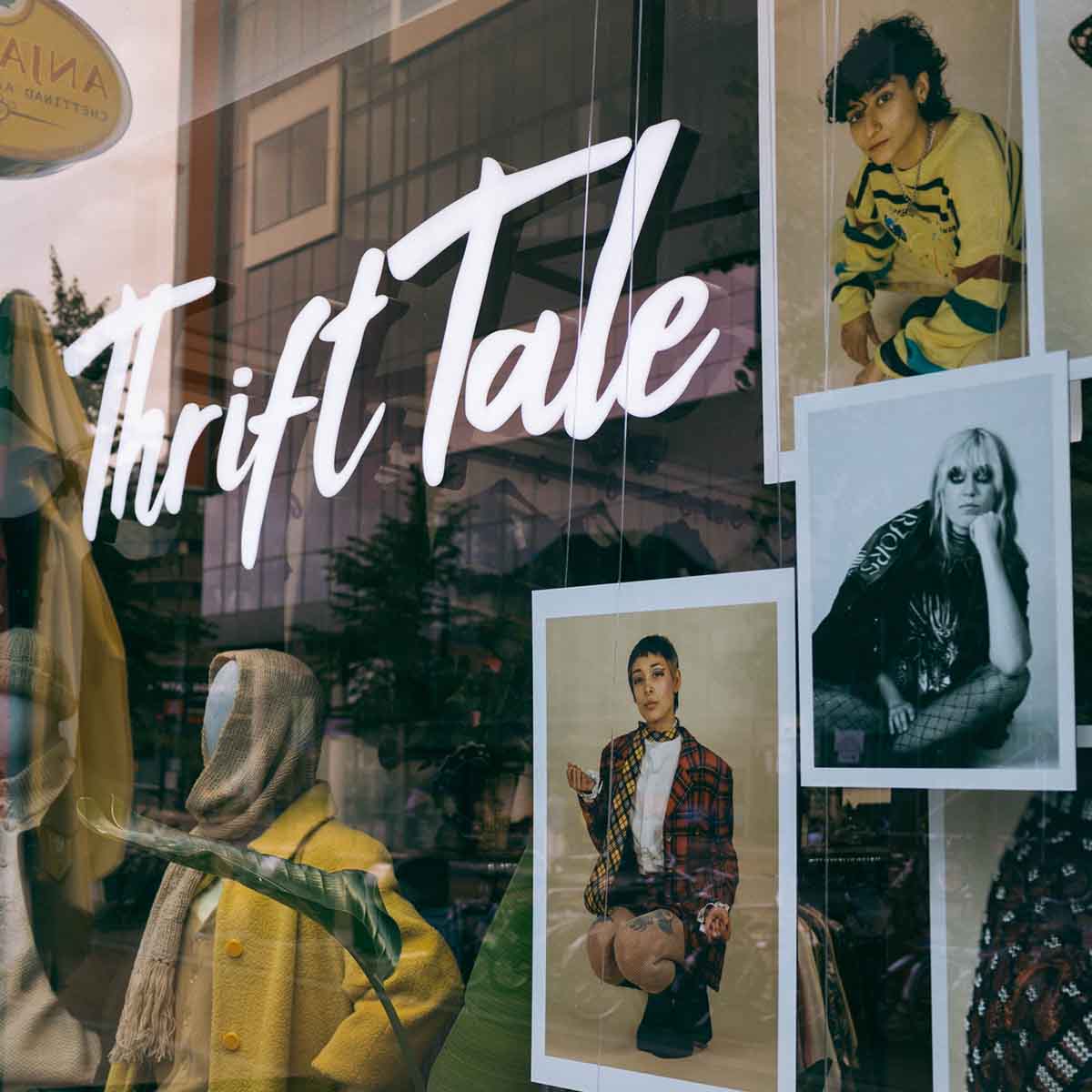
Or dive into our collection of vintage clothes at our experience stores in Utrecht and Enschede.
FIND A STORE
Looking for more vintage clothes? Want to see our stuff for real?
Grab your bag and get down to one of our stores for the best thrifting you can find in the Netherlands. We’ve packed them with even more of the good stuff, in the coolest locations.
Get that vintage quality and style that needs to be seen to be believed.